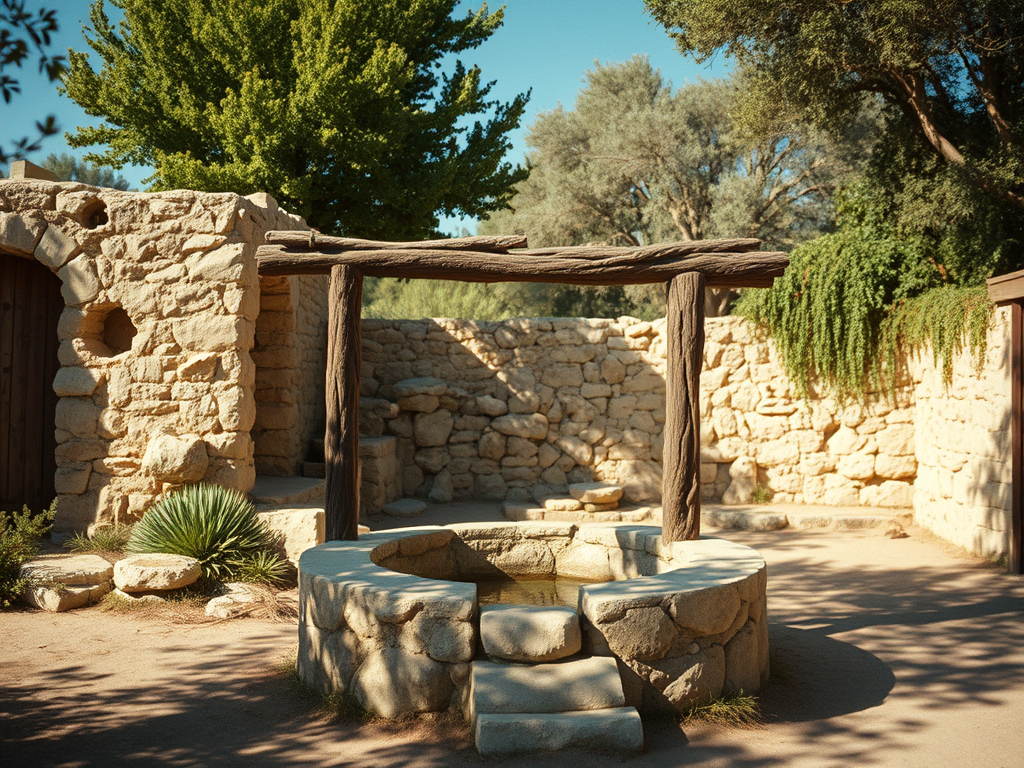
Part 1.
She stands there, her hair wet with sweat. Her breath catches in her chest. A man is sitting on the edge of the well. His dark eyes not looking away. The lone woman’s unease and lack of self assurance are quickly pushed aside. She tugs at her veil and arranges her face in quiet pride. It’s a challange to the stranger to assert his power, his authority. Her lowly position is easy to see. She averts her gaze in an offering of humility and gathers her thoughts as the man speaks.
“Give me a drink.”
Her mask slips for a moment as the pain from past abuse picks at a wound deep in her soul. She can easily see that he is a Jew and she wonders why he would take this road. A sudden jolt of indignation makes her voice sound louder than she intends.
“How is it that you being a Jew ask for a drink from me, a woman, a Samaritan?”
The silence lays heavily between them. The heat of the midday sun sends rivlets of moisture through the light layer of dust powdering his skin. As the man casually wipes his forehead she can see exhaustion behind his weary gaze, and she feels her own features soften as the muscles relax in her face.
“If you knew the gift of God, and who it is who says to you, ‘Give me a drink,’ you would have asked Him and He would have given you living water.”
The peculiar statement sounds like an offer. Who is this man the woman thinks. He is in no position to provide her with a drink. Her eyes narrow in keen apprehension as she assesses his demeaner and appraises the situation.
“Sir, You have nothing to draw with, and the well is deep.”
She can’t help but to glance at the jug resting on the ground near her feet.
“Where then do You get that living water? Are you greater than our father?”
Her back straightens and she lifts her chin. Drawing courage recalling her familial connections.
“Jacob gave us this well, and he drank from it himself…”
There are lonely afternoons when she imagines the sons of her ancestor gathered in this exact spot drawing water for their livestock. The stranger seems to know her thoughts.
His lips betray him with a slight smile. His eyes lighten with a curious look the woman hasn’t seen in a while. It’s the disarming countenance of an intimate friend. Or someone who loves her like a father or a mother, a sister or a brother.
Her face flushes in embarassment.
She looks down at her hands, blinking back a few tears trying to understand. How could the face of a stranger disarm her and make her feel this way? One look removing the armor she’s so skillfully made.
“Whoever drinks of this water will thirst again, but whoever drinks of the water that I give him will never thirst,” she hears him say.
There’s a dam in her heart and it’s threatening to break. His words burst through her walls. Her insides shake. Her defences are suddenly crumbling down. The woman is choking back her emotions feeling like she might drown.
“But the water that I give him will become in him a fountain of living water springing up to everlasting life.”
She meets his eyes to reply, “Sir, give me this water that I won’t thirst or come here again to draw.”
Her mind and her heart are at odds. Surely this man isn’t offering her an actual drink. But something inside her is awakening, bubbling up from a hidden spring. Her heart is pounding and she’s trying to think.
A messiah, a savior, is supposed to come. Secretly she’s said prayers to the Holy One. Though she’s felt dead inside for so many years, a small part of her has hoped that the God who is rumored to bottle men’s tears would hear.
Except what the man says next confirms the woman’s deepest fears.
“Go, call your husband, and come here.”
Her heart sinks and her cheeks darken with shame. Of course a woman like her could never lay claim to any promise of life. There will be no living water for her once the stranger has recognized the true person he’s met beside the well. She briefly closes her eyes, lets out a soft sigh, and decides to tell.
“I have no husband.”
The words are true, but an image of the man she lives with flashes in her mind along with the faces of the other five. Men who once promised to love her. Men who broke her and lied. Without the protection of a man she may as well die. Her shattered heart no longer longs to be loved. She’s berated herself and hated herself, but it hasn’t been enough to quench the smallest desire to be seen. Her chest tightens and she feels like she can’t breathe.
“You have well said, ‘I have no husband, for you have had five husbands…”
Does he mean to shame her? Blame her? Dig up her past? Is he trying to uncover the tangled mess of wounds that seem to last lifetimes. Passed from parent to child, bound by a curse. Generations of hurt, layered like the dirt packed under their feet.
“…and the one whom you now have is not your husband; in that you spoke truly.”
She gathers the shreds of her dignity and once again arranges her face in a mask of cool humility preparing her speech.
“Sir, I perceive that you are a prophet.”
Though her mind is screaming for her to retreat, and her defensive demeanor is returning with ease, the woman decides she is done feeling empty. Stepping over her wounded pride she can’t ignore the feeling growing inside. It’s like the living water that the man described. It’s expanding and filling the deep well in her soul. The woman has to know.
“Our fathers worshiped on this mountain, and you Jews say that in Jerusalem is the place where one ought to worship.”
The small smile tugs once again at the man’s lips and she briefly wonders what it is that pleases the prophet.
The questions behind her statement have plagued her as she’s pled for God’s mercy, waking early to present meager offerings. But the mountain top alter failed to make her feel clean. Maybe a trip to the temple is what she needs to finally bring her soul peace.
It’s as if the prophet has listened in as she’s laid bare her anxieties, as if he’s walked beside her those quiet mornings.
“Woman, believe me, the hour is coming when you will neither on this mountain nor in Jerusalem worship the Father. You worship what you do not know, we know what we worship for salvation is of the Jews.”
This is nothing new. The woman knows the history. She understands the debates and the controversy. Yet her heart only longs for one thing. Understanding. A God who sees her. A God who knows. A God who isn’t so Holy that He can’t come close. A God who is willing to meet her outside of the temple, and away from the mountain. A God who is willing to engage in a simple conversation.
“But the hour is coming and now is, when true worshipers will worship the Father in Spirit and in Truth for the Father is seeking such to worship Him.”
Could God ever seek her? Her mind lets this thought sink in sifting through the words, but it goes against everything she’s learned. God’s presence must be earned. How could she possibly deserve a meeting with the creator of the universe?
Recollections of hours spent talking out loud to God like He is her friend make her suddenly feel foolish to imagine that He would listen.
“God is Spirit and those who worship Him must worship in Spirit and in truth,” the prophet says.
A flood of memories come in quick succession. There are the countless moments on the mountain, but there are also the mundane tasks of her every day when her loneliness is crushing and her heart instinctively prays. There are the little songs of praise that spontaneouly errupt when she is filled with thanks. And there are the unbearably hot middays spent here at this well drawing water by herself. She wonders if God is Spirit could her spirit worship Him too? She studies the man standing before her and she sees the truth.
“I know the Messiah is coming and when He comes He will tell us all things.”
Her questioning reply changes His eyes. The man is looking at her reflecting her deep longing. She sees her confusion and her suffering, she sees her hope and her broken dreams. She sees the unspoken prayers when she wished her life would just end. Why would God even create her when He knew her life would turn out like this?
She blinks but she can’t look away. Could she really be looking at His face? The Christ, the Messiah, the Coming One? God in flesh? His Holy Son?
A power hits her as a light wind disturbs the trees. The man opens His mouth with authority.
“I who speak to you am He.”
Part 2.
Looking up from the book laying across her lap another woman sits surrounded by tall grass. There is a slight breeze rustling the leaves of the aged trees bending over the river’s edge. The young woman inhales a deep breath. Jesus. She’s heard His story and memorized Sunday school prayers. She’s come to the end of herself and asked God if He’s there.
She’s felt Him answer with a tangible presence of power and love, yet she’s wondered if this book is really enough. Could the words written on these pages change the course of her life? She feels a stirring inside. Could she really just believe? Could she really find forgiveness and inner peace?
It was her boyfriend who had held up this Bible and told her it contained the answers that she sought. Except the more she read it the more confused she got. He had insisted all other paths to God mixed truth and lies, but by reading this holy book she would find out that Jesus really is the Christ. She agonized over the Old Testament laws and the temple sacrifice. It wasn’t until she read about the man, Jesus, who claimed to be the way, the truth, and the life, that she realized she didn’t need to bring a lamb to a priest to have her heart purified.
This day it all starts to make sense. The presence in her room from years before, the testimony of her boyfriend telling her, “Jesus is Lord,” and the words in these pages as she sits beside the rivers edge.
“Jesus,” she whispers, “I know you are true. I want to follow you.”
It’s like the wind and the river are one. They blow through her and flow out of her as she feels God’s Spirit come.
Her own spirit feels alive. She gathers her belongings and walks back to the orchard camp where she resides. Her insides bursting with joy. She can’t help but testify of her new found knowing.
“What happened to you? Your face is glowing…” a friend who has traveled across the country with the young woman and her boyfriend asks.
He is a seeker too.
She laughs, “It’s all true. Jesus is showing us the way to life. All we do is decide.”
Her friend’s words pierce her heart like an arrow, “Oh, so now you will be a person who’s mind is narrow…”
The disappointment in her good friend’s response feels like a slap in the face, but nothing can erase the change that happened to her. He rejects the claims of Jesus as Christ. He’s looked into the Bible and denies His diety. A prophet, yes maybe. But the son of God freeing the world from sin? Giving all people His gift of love and accepentance? Her friend tries to explain, how Jesus is an offence. How could one man be the only way? What about the rest of the world who could never believe? The ones born in a time and place where it would be impossible to recieve even a whisper of the truth. How could she be so decieved?
Her friend seems angry. The young woman has to admit that she doesn’t know. But as her confusion begins to grow, peace settles in her soul.
The woman’s boyfriend isn’t home, and as her friend continues to argue, the young woman’s mind begins to roam.
“Righteousness and justice are the foundations of Your throne…”
The words written so long ago, by a king who severly lacked both, for a God to whom he dared to draw close, a dichotomy explained in prose.
“Mercy and truth go before Your face…”
The king who wrote this psalm a thousand years before the birth of his Lord saw truth and grace. The Messiah, the fullness of the law, the Word who was in the beginning and is God. Yet this mercy, this justice, this righteousness, could it be summed up in only one truth? Could the God who created all things become human too?
The One who holds the stars in His hand was born on the earth as a man. Fully God in corruptable flesh, fulfilling the law with His holiness.
Her boyfriend comes in from the fields and her friend finally yeilds. The woman’s new faith has replaced her uncertainty. She believes. Her boyfriend notices the change too. Some of her excitement fades as she explains the change. When he embraces her, she is relieved. She knows that he is pleased, and her troubled mind is eased.
Yet her friend’s questions remain. Her brow furrows as she ponders her new found faith.
Part 3.
That night the young woman settles into her cot, the events of the day replay as she attempts to quiet her thoughts. The cabin in the orchard camp is dark as she closes her eyes. In her mind she is transported through space and time. She is at the well with the Christ when the disciples return. They are shocked to see Him talking to her. She’s the woman with the waterpot. She is the woman whom the Messiah sought.
They don’t say a word but in their expressions the disciple’s thoughts can be clearly heard. Why would Jesus speak with her? The woman takes a brief moment to acknowledge them, remembering that she is a despised Samaritan. She is confident as she slightly tips her chin. Her eyes unable to hide her joy at the Messiah’s revelation. She leaves her pot next to the well and goes her way into the city to tell the men,
“Come, see a Man who told me all things that I ever did…”
She wonders aloud, “Could this be the Christ?” And many believe as she testifies.
Some of them had been wondering too. Is there a God who cares about the things that I do? When I pray does He hear me? When I sing does He know? When I am sad does He long to come close?
Back at the well the disciples offer Jesus a meal and urge Him, “Rabbi, eat.”
But he answers with, “I have food to eat of which you do not know…My food is to do the will of Him who sent Me…”
They question one another about who had met their master’s physical need. They remember how He was hungry when they left him there by himself, looking parched and dusty at the edge of the well.
He interrupts the men, His face lighting up with passion as He explains to them,
“My food is to do the will of Him who sent Me, and to finish His work.”
Now the disciple’s take a moment to decifer His words.
Their Teacher goes on to explain,
“Do you not say, ‘There are still four months and then comes the harvest’? Behold I say to you, lift up your eyes and look at the fields, for they are already white for harvest!”
His excitement contrasts with the diciples’ bewildered expressions. The teacher is just getting started though with His lesson.
“And he who reaps receives wages, and gathers fruit for eternal life…”
His unhindered joy is impossible to hide.
…that both he who sows and he who reaps may rejoice together.”
Jesus is beaming at them as He lectures. He is glowing, knowing that the Samaritan daughter, drank deeply of the living water.
His voice lifts like a love song, and His hands dance along as He strives to convey the ideas glittering behind His eyes,
“For in this the saying is true: ‘One sows and another reaps…’”
His gaze is powerful as He looks at each man endeavoring to see. Do any of them percieve His glory? Do they understand that He is the One who gives life? That for life to come One must die? That He is both the harvester and the planter of the seed? To reap everlasting life a man must simply believe?
The disciples nod at the familiar phrase. Now they understand what Jesus is trying to say. When one man sows and another reaps, one man works while another sleeps. One man gives and another man keeps.
“I have sent you to reap that for which you have not labored, others have labored, and you have entered into their labors.”
Jesus speaks with conviction, His voice never wavers.
They nod again like this makes perfect sense. Their Messiah is here. Things are about to get intense. The world will finally recognize the truth. To know God you must be a Jew. The law was given to Moses and passed down through the prophets and priests. The temple, the Torah, the most Holy feasts. The disciples can see, the works of their ancestors never ceased.
But there is something that the disciples may have missed. Because there was a moment when mercy and truth met together; righteousness and peace kissed.
A conversation once transpired at the edge of a well, between an unnamed woman and God Eternal. All of her secrets were laid bare, as she was made aware of the Messiah who had to meet her there.
Another woman had her longings revealed. Beside a river her soul was delivered, and her heart was healed. Gods word sanctified her. Washed and made clean, both woman believed Jesus was who He claimed to be.
They both realized that the Christ, the Savior is not just for the Jews, He is not just for the righteous, or those born with the truth. He belongs to the lost, and those seeking to be free, from the crushing weight of sin that plagues humanity.
The Word became flesh and stood before men. He called them His disciples and He called them His friends. He labored alongside them reaping a harvest only He could sow, row by row, plowing a path maddeningly narrow.
So, if you are the woman at the river, or the woman at the well, if you are one of the men who they couldn’t wait to tell, or if you are one of the disciples so sure of yourself, you can know that Jesus finished His work when he suffered death on a cross, rose from the dead, and defeated Hell.
“Behold! The Lamb of God who takes away the sin of the world!”


Leave a Reply