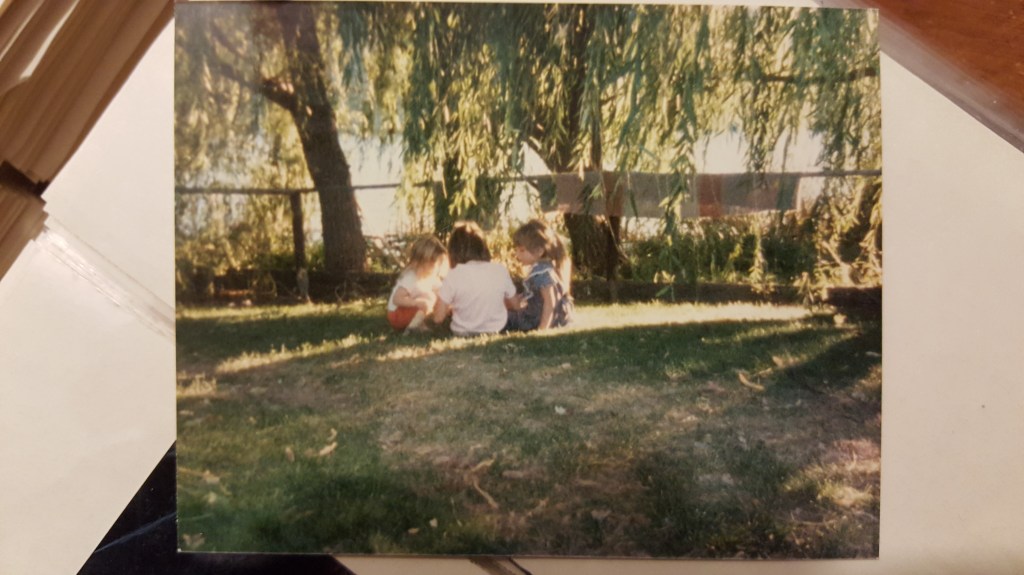
Okanogan Valley Washington
Summer 1988
There are four years that the family from the mountain enjoy the modern conveniences of electricity and running water. At the end of the summer she turns four the little girl’s dad decides to take a full-time job in an orchard and they move into a two bedroom trailer owned by the orchardist. She can remember running through the house flipping the light switches off and on in amazement with her brother and younger sister. This little home in the valley is an answered prayer to her mother who soon would be pregnant with her fourth child. The indoor toilet, electric heat, washing machine, and a faucet that has clean water, both hot and cold, are luxuries that change her life. These years are known to the family as “down in the trailer.”
The summer the girl was seven going on eight brought them back up to the mountain. An event that is clearly etched in her mind yet disjointed defines the end to the ease of life in the valley. Fear, not her own, but again her mother’s, marks this moment as one of those memories that clings to her almost thirty years later.
The day is warm and the little girl is playing with her sister down by the lake. They are making what they like to call fried chicken.
“This looks so delicious.”
They pretend to eat the concoction of stones wrapped in algae, rolled in dirt, then dried on the rocks beside the water. They are careful to never go into the lake. Their mother has explained to them the dangers of water and they know to obey her, besides, there are duck lice that cause itchy red welts to appear on their skin if they decide to wade between the rocks. There is a worn bank with shallow water that is shaded by elderly willows. Red winged black birds perch in the long cat tails growing in the marshy waters that edge most of this end of the lake. In the winter when the lake is frozen the little girl and her brother love to make tunnels through the tall reeds.
He approaches them with a long stick that he has broken from one of the willows. His sly smile and mischievous eyes cause the girls to drop their pretend meals.
“Leave us alone,” says the oldest in her snottiest voice, “I will tell Mom.”
The brother’s smile only grows wider. He loves his little sister, but what he loves more is making her scream. He has perfected his art and it doesn’t take much to get that satisfying squeal to burst from her little chest. A small movement of his wrist is all it takes to make her dart into the grassy yard. He runs behind her with the stick raised above his head feeling the thrill of the chase. She flees yelling for her mom around the rear of the small trailer. It’s white corrugated tin siding is rimmed with pink hollyhocks. There is a small rickety wood back porch with a door that leads to the kitchen and an awning covering a wide concrete slab that welcomes visitors at the front of the house.
The little girl runs past the back door under a clothes line draped in sheets and toward an aging peach tree along the side of the house. She is surprised by her stick wielding brother at the corner of the front yard. He is so delighted to see that his trickery has paid off that he doesn’t hear the sound of the tractor pulling into the dirt lot on the other side of the wire fence.
Their father’s loud voice stops him in his tracks. Her brother quickly discards the stick into the taller grass on the other side of the fence and attempts his most innocent look. His dad’s stern glance their way tells them both to keep silent. Their father walks into the yard and takes a moment to look at the oldest two of his offspring. They are barefooted and tanned from the summer sun. They both have gap toothed little smiles and are clothed in clean shorts and printed t-shirts.
“You need to stop torturing your sister,” he says to his son and lays his hand briefly yet protectively on his daughter’s head before going inside. All excitement now drained from their confrontation the brother and sister become tentative friends. Their relationship is a series of close adventures, heated arguments, tearful rejections, and amiable collaborations. For now they are in the neutral territory between friend and foe.
“Do you want to ride bikes?” he asks the question like he doesn’t care really if her answer is yes or no.
“Sure,” she responds a little too eagerly always ready to make amends with her brother. She knows he would never actually hit her with the stick. The running and screaming is just as much of a game to her as it is to him. In fact sometimes she screams just to hear her dad scold him.
They slip their feet into the sandals tossed by the front door and grab their bikes from where they are leaning against the scroll patterned wrought iron supports to the awning. The girl’s bike is pink with black foam wrapped handle bars. The foam is peeling from the metal where her brother’s friend tore it in a wreck. She is sad every time she notices this imperfection on her once new and beautiful bike that had been a gift from her grandfather in Seattle.
Sometimes she and her brother ride their bikes up and down the orchard roads and along the irrigation ditch, but today they stick to the gravel parking lot in front of their house. The area is slightly sloped and just long and wide enough to pick up some speed while peddling wildly, as children who have fallen enough times on their bicycles to no longer be scared do. Their riding is hindered by the tractor that their dad drove home on. There is a large sprayer hitched to it crowding the riding area even more, but they zoom around the obstacles challenging their skills.
Across the lot there is a group of cinder block cabins that house the seasonal workers. The men are arriving home from their day and the kids can see them gathering around the doors to their small homes. Usually there are no women or children living in these little houses. It’s groups of ten to twenty young men who travel from Mexico to work the apples. During the winter the camp is empty but in the warm months when work is plentiful it is bustling with activity. The children are not to talk to the men but a few of them have become familiar to them.
One of the men, Hector, is pulling into the lot in his small blue truck. He smiles broadly at the kids and waves. They wave shyly back and peddle over to their yard. It is dinner time and their mother is calling to them to come inside.
Their dad is sitting in an embroidered antique chair watching the news, smoke is curling up from a hand rolled cigarette that he taps against his knee to remove the excess ash. His foot rests on a matching stool with ornate carved wooden legs. Grandparents from out east who travel every summer to visit brought used furniture from the homes of relatives. There is a dark hardwood rocking chair with a matching side table. A formica dining set with padded chairs is placed in front of a large window. Their little sisters are sitting on a blanket on the living room floor with dolls and stuffed animals arranged in a serious imitation of family life. The girls sweet voices quietly echo a conversation they recently heard. Their mother is in the kitchen draining spaghetti noodles into the sink with hot steam rising up around her in a fog.
The kids have barely sat down at the little table when there is a knock at the door.
Their dad opens it to find Hector standing there. He has a large bottle of beer in one hand and a grocery bag in the other. “I brought treats for the nino’s,” he says holding up the bag. Hector has a thick accent but speaks very good English. He opens the bag and pulls out Jello pudding cups. The children’s eyes grow wide with excitement. Store bought pudding is so rare in their home that they could tell you each time they have had it.
Hector is pleased with the reaction of the children as he hands the bag to their mother. Even though it is dinner time she lets them indulge in the treat while Hector stands and talks to their dad. The men just received their pay and though they send most of it home to their families they spend some of it on themselves. Tonight they are drinking.
The kids have devoured their puddings by the time Hector walks back across the lot. More cars are pulling in and the little girl recognizes the small black camero of another man who sometimes comes over to their house named Juan. She notices him because he is young and handsome. Sometimes he has his brother with him. Her father drinks with the guys on these nights. They all end up in their front yard for a time wrestling and laughing together. The mother is watching out the window too and comments about another party in the orchard camp. These are common around payday but usually harmless.
The girl is finishing her dinner and her father has come inside to eat also. Her sisters are done but her brother is still sitting beside her. Spaghetti sauce stains her mouth and hands. She is always baffled at how others can eat without getting food everywhere. Her mother is standing to get a washcloth when she freezes. A look of terror clouds her face and she yells at the kids.
“Get down!”
Confused, the girl obeys and climbs down off her chair. There is a loud bang followed shortly by Juan crashing through the back door. Blood is streaming down the side of his face.
Her mother hurries her and her siblings into the bedroom.There is loud crashing. The girl is pressed against the dark cold floor under her sister’s crib hiding from whatever had terrified her mother and made the blood come from Jaun’s head. The kids remain huddled behind boxes under beds hidden for the rest of this evening until after the police arrive. When their mother feels it is safe they are taken down to the neighbor’s to sleep in a strange place for the night while their home is treated like a crime scene.
Over the next few days the little girl pieces together what happened. She listen’s to her parents repeat the story to family and friends. An argument broke out in the orchard camp and Hector shot Jaun’s brother point-blank in the chest with a shot-gun. After killing his brother, he chased Jaun across the parking lot intending to murder him also. The shooting of Juan’s brother was obstructed from view of the family at the table by the tractor and sprayer parked in the lot between the trailer and the camp. The girl’s mother though, witnessed Hector raise the gun and fire at Juan as he ran along the side of the house past the peach tree being sprayed with shot-gun pellets, and then Jaun stumbled in the back door bleeding and shouting,”He killed my brother!”
The girl’s unarmed father without hesitation walked out the front door to confront Hector who stood at their fence. Her mother watched her dad stride up to the man who had just murdered one person and who was attempting to murder another, grab the gun from his hands, and break it over his knee. He then held Hector until the police showed up. Jaun tried to follow her dad outside and was pushed into the table that the family had just been sitting at eating dinner. The formica was broken in half when he fell through it. Juan’s blood that dripped from his superficial head wound was smeared over the broken dining set and throughout the house. This is what glared most vividly as the little girl was led from the shelter of her bedroom and out the front door. The broken table and the blood.
It’s strange to tell a story from such a long time ago. As a child it is experienced in moments lived and in fragments of later conversations between adults listened carefully to. Her big brother remembers that Juan’s brother was shot with fishing weights loaded into the shotgun shells. Her sisters just have vague memories of hiding under a bed in a darkened room. From this night on the family no longer feels safe in their little home nestled between a beautiful lake and an orchard that provides their livelihood. There are threats made against the father for his involvement in disarming the killer. The family of the murdered man are gathered together and are angry that Jaun was prevented from avenging his brother’s death. Her father sits awake every night with loaded guns to protect his family until they retreat again to their little cabin on the mountain. They are hidden away and hemmed in by miles of dirt roads and armed neighbors who are known and trusted.
Murder brushes against us in bloody anger. Death plucks a man from the living. Children are at play in the sunlight one moment and pressed into hiding in a dark room the next. Living with light in the darkness. The weight of one man’s choice, like lead heavy in poisoned flesh spoils the peace of safety’s illusion, but one man’s light presses back the dark in another. In the confusion of blood and bullets fear is easily put on but instead of allowing this emotion to overcome him, the girl’s dad, walked up to evil, looked him in the face, and took his weapon from his hands. More than the bloody smears on the broken table and the cold floor beneath the bed, that day is marked with the decision the father made. The girl never had nightmares or was scared of men coming to harm her. She always knew that her dad would face anything to protect his family. “I would die for you,” were not empty words spoken. They were lived

 A TREE BY THE SEA
Leave a comment